
5 Signs Your Church is Ready to Launch Community Outreach
How to Launch with Confidence
Think of readiness assessment like a pre-flight checklist. Pilots don't skip the checklist and just hope everything works. They systematically check every critical system before takeoff because lives depend on it.
Community outreach readiness is your pre-flight checklist. The community's well-being depends on you getting it right.
Knowing you're not ready to launch community outreach efforts keeps you from making costly mistakes, plus It gives you a roadmap for what to work on first. It protects your future outreach effectiveness by ensuring you build a proper foundation.

#1. Your Leadership is Unified Around Your “Why”
When I ask, "Why should your church engage in community outreach?" and your senior pastor, elders/board, and staff team all give similar answers rooted in Scripture and mission, that's a green light.
When those same leaders can articulate the connection between community outreach and your church's overall discipleship strategy, that's an even brighter green light.
But when only one person is passionate about community outreach while others are indifferent, skeptical, or even resistant? That's not readiness—that's a setup for failure.
Green Flags to Proceed:
- Leadership meetings include regular discussion of community engagement
- Budget allocations reflect the priority of outreach
- Senior pastor references community engagement from the pulpit naturally, not just when asked
- Board/elder meetings ask "How does this decision affect our community presence?"
- Staff members from different departments coordinate around outreach initiatives
Red Flags to Postpone:
- You're the only one bringing it up.
- Others nod politely but never initiate conversations about community outreach.
- When you're absent from meetings, community engagement isn't discussed at all.

#2. You Have Capacity For the Long Haul
Ready churches understand that effective community outreach is measured in years, not months. They have both the emotional bandwidth and the organizational capacity to commit for the long term.
This means:
- Key leaders aren't already overwhelmed with other responsibilities
- The church isn't in crisis mode (major transition, significant conflict, financial emergency)
- There's a realistic understanding of the time investment required
- Systems exist for maintaining consistent presence in the community
I often ask: "Can you commit to showing up consistently for the next 12 months, even when it's not exciting, even when volunteers are scarce, even when results are slow?" If the honest answer is "maybe" or "probably not," you're not ready yet.
Green Flags to Proceed:
- You have (or can create) a part-time or full-time staff role for community outreach, OR you have a volunteer champion with significant available time (10+ hours/week)
- Your church calendar has margin—not every week is packed with competing programs
- Leaders talk about "three years from now" not just "three months from now"
- There's patience with slow growth and gradual progress
Red Flags to Postpone:
- Your church is already running at 110% capacity.
- Your potential champion is already stretched thin with other responsibilities.
- Leadership wants to see results in 90 days or they're moving on to the next initiative.
#3. Your Congregation is Willing to Learn
Ready churches approach community engagement with humility, not arrogance. They're willing to listen to community leaders, learn from mistakes, and adjust their approach based on feedback.
The most dangerous attitude in community outreach is: "We know what the community needs, so let's just go fix it."
The most helpful attitude is: "We want to understand what the community needs and then explore how we might partner in addressing those needs."
Green Flags to Proceed:
- Willingness to conduct listening sessions before launching programs
- Openness to feedback from community partners (even when it's uncomfortable)
- A congregation that trusts leadership to make informed decisions based on research
- History of learning from past ministry failures rather than repeating them
- Cultural humility—recognizing that you don't have all the answers
Red Flags to Postpone:
- Your church has a history of "knowing what's best" for others.
- There's resistance to listening to outside voices.
- Past community partnerships ended poorly because your church didn't take feedback well.

#4. You Have People, Not Just Ideas
It's easy to get excited about community outreach in theory. It's much harder to find people willing to show up every Tuesday at 3 PM to tutor kids, attend monthly partner meetings, handle logistics, communicate with volunteers, and track outcomes.
Before you launch, you need to know: Do we have people who will actually do this work consistently?
Green Flags to Proceed:
- You've identified 3-5 people who've expressed interest beyond just attending an informational meeting
- These people have demonstrated reliability in other church contexts
- They have relevant gifts/skills (relational, organizational, servant-hearted)
- They're willing to commit to specific time blocks on an ongoing basis
- You have a mix of leaders and workers (not everyone can be "the idea person")
Red Flags to Postpone:
- You have lots of people who say "that sounds great!" but no one who says "I'll commit to showing up every week."
- Your core team consists of only one person (you).
- The people expressing interest have a history of starting strong but not finishing.
- Everyone wants to lead; no one wants to serve.
#5. There’s a Natural Connection to Your Church’s DNA
Every church has a unique DNA—a combination of gifts, passions, resources, and calling. The most sustainable community outreach leverages that DNA rather than fighting against it.
A church filled with educators naturally partners with schools. A church with a strong recovery ministry naturally extends that into the community. A church with deep refugee populations naturally welcomes more refugees.
When community outreach feels like an extension of what your church already does well, rather than a completely new direction, you're ready.
Green Flags to Proceed:
- The proposed outreach aligns with your church's stated mission and values
- Your congregation has demonstrated gifts and skills relevant to the community need
- There's existing passion (not manufactured enthusiasm) for this area
- This outreach builds on something you're already doing, so it feels like a natural next step, not a random pivot
Red Flags to Postpone:
- The proposed outreach has nothing to do with your church's mission or gifts.
- People are interested because it sounds good, not because it matches their actual passions or skills.
- It requires your church to become something it's not.
Still Unsure of Your Readiness?
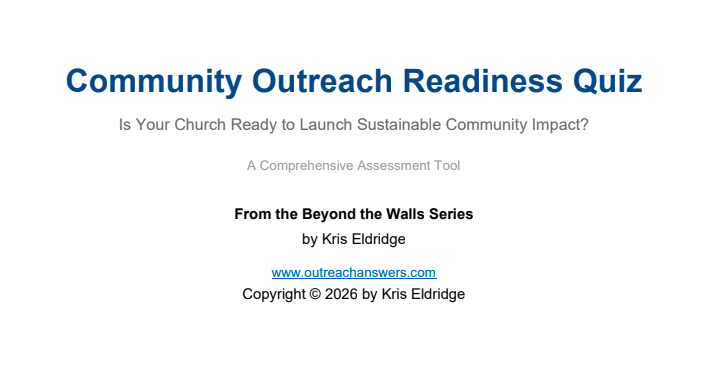
Want a more detailed assessment of your church's readiness?
Linked below is a comprehensive Readiness Quiz that walks through 20 specific questions across these categories:
- Leadership Alignment
- Capacity & Resources
- Congregational Culture
- Community Understanding
- Organizational Infrastructure
The quiz takes about 10 minutes and gives you a readiness score with specific recommendations based on your results.
Download the free Community Outreach Readiness Quiz at www.outreachanswers.com
“But We Aren’t Completely Ready…”
So you have some readiness indicators, but not all. Maybe your leadership is aligned but you don't have people yet. Or you have people but no community understanding. Or you have everything except capacity.
That's actually great news! It means you know exactly what to work on.
Here's my recommendation: Pick your weakest area and spend the next 90 days addressing it before launching anything new.
Weak on leadership alignment?
Spend 90 days having strategic conversations with key leaders, sharing vision, addressing concerns, and building buy-in.
Weak on people?
Spend 90 days recruiting and developing a core team through relationship-building, vision-casting, and small group gatherings.
Weak on community understanding?
Spend 90 days doing listening tours, stakeholder interviews, and community research.

Don't try to fix everything at once. Focus on your biggest gap first.
And here's the most important part: be honest. Don't inflate your readiness because you want to move forward. Don't minimize challenges because you're excited about the vision. The most loving thing you can do for your community is to make sure you're truly ready to serve them well.